
S2. Ep2 - Can AI Replace Your VA? A Conversation with Ashley Kay of Champagne Collective
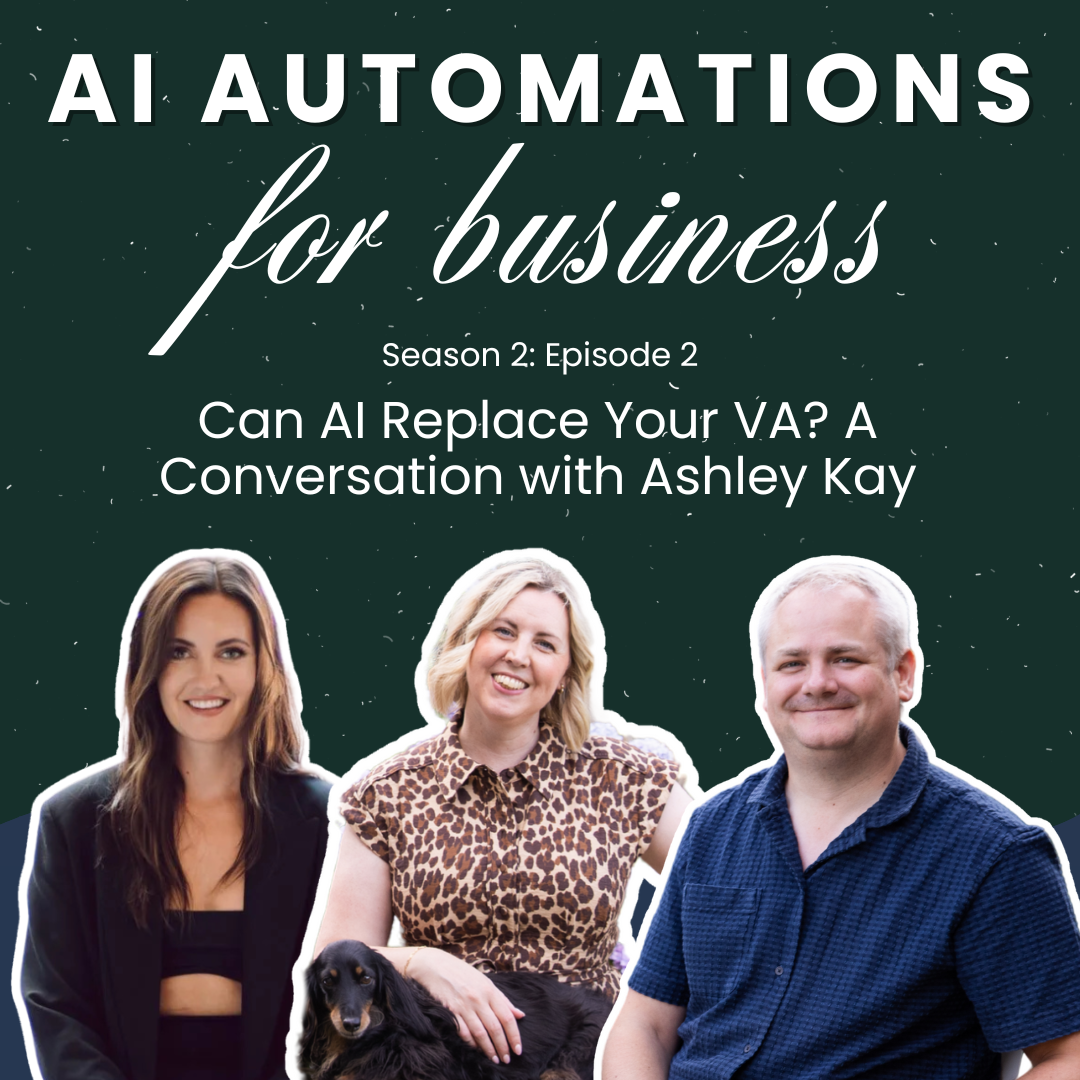
Is AI really going to replace your virtual assistant? In this episode, Katie and Noel sit down with Ashley Kay, founder of Champagne Collective, to debunk the biggest myths circulating online about VAs and AI. Ashley runs a thriving VA and OBM agency supporting nearly 100 female-owned businesses worldwide, and she's got strong opinions about the "AI will replace VAs" narrative flooding social media.
You'll discover why AI is a powerful tool but not a replacement for human strategic thinking, empathy, and authentic brand voice. Ashley shares fascinating insights from her agency's experience: 50% of clients want AI everywhere, while the other 50% strictly forbid its use. She explains how VA roles are actually evolving upward into strategic OBM positions as AI handles repetitive tasks, the critical importance of transparency when using AI in client work, and why consumers can instantly spot AI-generated content (and why that matters for your business).
Perfect for business owners navigating the AI-versus-human support decision, VAs worried about their future, and anyone who wants to understand how to combine AI tools with human talent effectively.
Learn more about Champagne Collective at champagnecollective.co and follow Ashley on Instagram.
How to find us:
Join our membership over on Skool, where we support you on your AI and automation journey. We share exclusive content in the membership that shows you the automations we talks about in action how to build them. Find out more about the AI Business Club here.
We have a free LinkedIn group (AI Automations For Business), the group is open to all.
New for 2026, you can also find us on Substack, click here to subscribe and get all the latest news and updates from us.
If you would like dedicated help with your automations or would like us to build them for you then you can find our agency at makeautomations.ai
-
Katie (00:27)
Hello and welcome back to another episode. Hi, hello, always, it's me, Katie, and I've got Noel here with me as well. Hi, Noel. How you doing?
Noel (00:34)
Hello. Amazing as always.
Katie (00:40)
And also joining us today is the amazing Ashley Kay of Champagne Collective. Welcome, Ash. I'm so, so excited that you're here and talking with us today.
Ashley Kay (00:52)
Hi, thanks so much for having me.
Katie (00:55)
Before we dive in, Ashley, would you like to introduce yourself and share a little bit about the work that you do and tell us who you support?
Ashley Kay (01:07)
Yeah, absolutely. So I own and run a virtual assistant and online business management agency, also known as VAs and OBMs. And we provide a vast range of VA and OBM support services to female-owned companies around the world. We primarily work with coaches and marketing and social media agencies. But we also have a variety of other clients like makeup artists and photographers and jewellers. And we work alongside our clients as their partners to help streamline their backend, optimise their systems, manage and handle all of their admin support, sometimes marketing support and a variety of other areas.
Katie (01:57)
Yeah, amazing. The work you do is incredible. What I'll make sure is at the end, we'll put like all your website and Instagram and social media details so people can check you out. So yeah, we'll make sure to drop those in for everyone as well. Amazing. Okay, so today we want to talk about like AI and like VAs. So I feel like there's quite a bit of noise on the internet at the moment that, you know, VAs are worried that AI is going to replace them. And I think what we would love to hear, Ash, is from you, like, what's your take on what's happening.
Ashley Kay (02:53)
Yeah, definitely. Yeah, there's a lot of noise is a good way to put it in the online space and a lot of trending videos and posts and articles about how AI is taking over the VA space, AI is going to replace VAs. And I mean, in my opinion, it's just not a thing that's ever gonna happen. AI is amazing. I love AI. We use AI at Champagne Collective. I use AI extensively personally.
And it's an incredible tool, but that's just it. It's a tool. It's not a person. It's not a human that has a conscience or empathy or the ability to connect with other humans or make critical decision-making or lead a team. And I think a lot of what's being said about VAs and AI, well, number one, VAs are often a lot more than what a lot of people are depicting VAs to be in these articles and videos and things you're seeing. Like, AI could take this over, but VAs do so much more than you may think or know for AI just to be able to step in. Absolutely. There are tasks and things that AI can do. The repetitive or the things that don't require that critical thinking intervention or that strategic thought partnership and utilise AI for that. Like it's a tool.
Like any other software programme or tool you would use in your business, right? You want to leverage it. You want to utilise it for its capabilities and functionalities, but you also need to remember that it's not a person. It has no ability beyond a computer to connect. It has no ability to troubleshoot in real time when people are involved or do a variety of things.
I mean, in my opinion, AI will never take over VAs or VA roles entirely, but I do think that AI is a really, really valuable tool that VAs and VA agencies and company owners can utilise alongside VAs in their businesses.
Katie (05:02)
Yeah, I 100% agree with that.
Noel (05:04)
So have you seen the VA and OBM roles shift since like tools like ChatGPT and things that have come in, come out and also like AI agents and things like that.
Ashley Kay (05:17)
Yeah, definitely. I think the biggest shift that we've seen in the industry is the evolution of VA and OBM roles. OBM, for anyone who doesn't know the difference between a VA and OBM, it's probably good for me to clarify that. VA is much more task doers. Here's the task completed, very task-based. OBM roles are very strategic in nature, thought partnership, thought leadership.
Think of it as like your right-hand person in your business. So one of the biggest like evolutions that we've seen, changes we've seen in the industry with tools like ChatGPT and AI is that VA roles have expanded and evolved so much to start moving more into that OBM role of that strategic partner, right? So less of the here's a task completed because a lot of those repetitive tasks like calendar bookings or these other things we can utilise AI to do. We can utilise AI to do A, B, and C, whereas before a VA may have been doing that, which has allowed and given VAs the opportunity to fill that space by expanding their role. And things like ChatGPT or AI tools, they're also really, really great for training and up-levelling VA skill sets.
So they've also given the opportunity to learn more, to expand their skills, to grow, and to be able to support clients in a more valuable, higher touch, more impactful nature, right?
Katie (06:56)
Yeah, do you find that clients are expecting different things now that they they weren't perhaps expecting before from from you guys?
Ashley Kay (07:09)
I'd say it depends on the client. I mean, in my experience, so we have almost 100 clients at Champagne Collective. I would say about 50% of them are really against AI. So they actually give us very specific instructions to not use AI in our support. They don't want it used in their business. And then about 50% are like, I want AI to do everything. To which we're like, that can't happen. So let's find a happy medium.
So with the clients who want AI utilised, it's like, yeah, we can utilise it. Here's the ways in which we can utilise it. So what we've been seeing, at least at Champagne Collective, is a trend of clients being like, how can we incorporate AI tools? And what would those tools allow us to take off of your guys' plate so that you can focus on different areas of the business or different things that I want you to focus on?
Can we get calendar management and this and this off of your plate so that you can focus on supporting me with this strategy or with my year long launch plans or these things that that critical thinking is required that AI can't do, right?
Katie (08:16)
Yeah. And, and is there, obviously I don't expect you to say anything personal about your clients, but those who are like, you you said 50% of them are really against AI. Is there a common reason for that or?
Ashley Kay (08:38)
Yeah, I mean, yes and no. Some of them don't even give reasons. They just like, don't want AI used. I would say most commonly what they say to us is just it's with a lot of our agency clients who are agencies. So marketing agencies, social media agencies. And what they say to us is like, I don't want AI used. Like people pay us to write copy or content or produce marketing assets or deliverables that are unique to their brand, to their voice.
And AI can never fully capture that, which is 100% the truth. That's a really big area where like us, Champagne Collective doesn't use AI for our clients. We write the blog posts, we write the emails, we don't get AI to write them because AI can't fully capture the nuances and intricacies and uniqueness of your brand and your voice and how you speak to your client and how you show up. And that's usually what we see our marketing agency clients say and our social media agency clients say is like, I don't want AI used because I don't want the content we're producing for clients to be robotic. It needs to be unique to their voice and brand, right?
Katie (09:54)
Yeah, no, I feel like Noel, you would have some input on what Ash has just been saying.
Noel (10:02)
So yeah, I mean that there is kind of ways of, you know, massaging the AI into, you know, creating content that sounds like you and that, but I guess there's always that point where it's like that it's never fully 100% going to give you that output that you would expect that you would write normally, but it could,
Ashley Kay (10:07)
There is. Exactly. I, yeah. Yeah, I totally agree. And it there's, well, there's so many different AI tools now. And some of them, absolutely. What your inputs can be changed to produce things that are more on brand that are more unique, but a trend that we're really seeing right now in the online space with anything content based is people can just tell when AI has written it. Like that's one of the biggest trends that we've been seeing this year is the pushback from consumers who are like, you know what, it's AI, I can tell, and if it's AI, it's not valuable content. So I think in those instances, that's another reason why we're seeing them push back on AI-generated content is because they can just tell. It's doesn't matter how unique you try to make the prompts, it's still gonna feel the way it feels, you know? And people know it. And so that's like a big pushback.
Katie (11:03)
Yeah, totally. Yeah, think a lot of the time when people do just copy and paste the result, they don't even bother to edit it. They just like they're just pumping out content for the sake of pumping out content. And that is like, oh my god.
Ashley Kay (11:08)
Right. Yeah, absolutely. And then the algorithm can tell too. Like these algorithms on all these platforms can tell that it's AI, you know? So then your content isn't being pushed. So it's like a multi-layer pushback of, you know, these platforms are combating AI with their algorithms and not pushing content and penalising it. And then people can tell and they're not engaging or resonating with it because they don't feel like it's genuine. And then if all you're doing is copy-pasting that from an AI tool, you're not telling your stories, you're not authentically sharing. So yeah, it creates this vicious cycle of you trying to push out a bunch of content, but the content isn't seen, it's not resonating, you're not building relationships because it's not you showing up.
Noel (12:03)
Yeah. And I think that's where people just go too far with it. Like they're just like, right, okay, write me 10 Instagram posts and they just literally copy paste it straight in there. When you should be using it for like help to give you an outline and ideas. And then you can kind of expand on them and write your own content, which then hopefully won't be picked up by like the algorithm or even your readers as AI slop.
Ashley Kay (12:13)
Yeah, exactly. Yeah, absolutely. So for us, like at Champagne Collective, we utilise AI tools extensively across the board in a variety of areas of our business and our client's businesses. But in areas like that, we don't. We create content for clients. We write the content. We don't get AI to write it. But we may use an AI tool to get ideas, to get a framework, to get support in creating an outline. And then we take that and we formulate a good piece of content with it. And that's a great way to use it as a support system, but not as a content generation tool, right? And that's where I think VAs and VAs and like OBMs really come into play is because we can utilise AI in that way to help us create better content, but we're still what's creating the content. We're still using our brain and our skills to generate that. And I think that's why VAs won't be replaced by AI is like, it's not a person who can create, right?
Noel (13:28)
Yeah.
Katie (13:29)
Yeah. I would agree with that completely. I think like with our podcast, we utilise AI a lot, but again, it's a support tool. It helps like with titles and like getting information together, like even scripts and stuff. But at the end of the day, it's us speaking on the podcast. So it doesn't...
Ashley Kay (13:33)
Yeah.
Katie (13:52)
It's us delivering it in a way that sounds the same every single time, you know.
Ashley Kay (13:56)
Yeah, yeah, absolutely. And that's what it's supposed to be, right? Like they literally coined the term, well, they didn't coin the term AI, but like they coined the term assistant, right? ChatGPT, it's in the title. Like it's a chatbot and then GPT, Generative Pre-trained Transformer. And so it's meant to be a support, you know, like an assistant. It's not meant to do your jobs. Like it just, it just can't. Like it has no human aspect.
Katie (14:26)
Yeah, but I think there are, again, going back to like services like VAs, I think there are certain tasks that AI could obviously help with. but there are other things like the more creative stuff that requires the human element and like the, the heart and the care and the, you know, being able to read a situation and being flexible and not rigid and not just doing the same task over and over again, like all of those traits that like a human obviously brings to the table.
Ashley Kay (14:54)
Yeah, yeah, absolutely. I mean, I think there are a lot of things like you're saying that can benefit from an AI tool being used to help support or complete. But yeah, there is so much that is nuanced and strategic or requires critical thinking or empathy or decision-making and that like AI just isn't there. And humans are always going to be an asset that you're gonna need in your business if you wanna scale, if you wanna grow, if you wanna build relationships, if you want to create impactful things. So yeah, I just think it's such a misrepresentation of what VAs and OBMs do to say that AI is gonna replace them because number one, it isn't. And number two, like there's so much more that VAs and OBMs do than I think is understood by people who are claiming AI is gonna replace them, you know?
Katie (15:50)
Yeah.
Noel (15:51)
Have you seen people, so from your like network of VAs and OBMs, like, have you seen like people kind of get anxious about these posts that are being going around or they just kind of like,
Ashley Kay (15:57)
Yeah.
Noel (16:05)
Oh, yeah. We know that we're not going anywhere.
Ashley Kay (16:07)
it's a bit of both. Like we've had a lot, we have, well, Champagne Collective, we have about 25 VAs and OBMs on our team that we have utilized and leveraged. And we've had a few come to us and be like, is my job safe? Like what's happening? Like, are my clients going to want me replaced by AI? And we've had a lot of conversations about that, but I think there's a level of anxiety or concern by people who don't know.
you know, so like when I'm having those conversations with my team, it's really a great opportunity to just give them that piece of mind that, know, I'm in the industry, I've been in the industry for a long time, I know what's going on and here's the reality and dispelling those fears and giving them the accurate picture of reality. But then there's also people in the VA and OBM industry who are like anxious or they're just, they don't know, you know, they're believing the things they're seeing.
And again, that's where having conversations like this, where we can shed light on the truth and the reality that like, no, it's not a thing or reading articles or people in the industry shedding light on the reality that like AI will not replace you or be a support in your business. It's not a threat to anyone's job. Like there's space for all those things to dispel the anxiety and the fears and support people in having a better picture of reality.
Noel (17:36)
Yeah, definitely. And I guess that the people that are saying, oh my God, AI is going to replace you. VAs, most of the time they're not VAs or they've never used VAs. They're just like these tech YouTubers or whatever that are just pumping out content to get views or whatever. They have no experience, have they? They're not actually in those roles or even used a VA at all.
Ashley Kay (17:43)
No, no, exactly. I'd say 99% of the people I've seen produce content on it, whether it's an article or a YouTube video or a post or whatever it is, I would say 99 % of them have never hired a VA, never been in the industry, have no idea what a VA does. Right. And so I think for people like us who know a VA can do, you know, we look at that content and we're like, that's ridiculous. This like, you don't know what you're talking about. But people who read that or watch it, who may not know what a VA is, or maybe they are a VA and they haven't been doing it long. They believe that's the reality. They believe the things being said. And then it creates this larger problem. Right.
Katie (18:41)
Yeah, you've got like the fear mongering and everyone's like sharing things without perhaps checking it or just like to get the traction.
Ashley Kay (18:46)
Yeah, yeah, exactly. And it builds this like narrative that isn't real. Right. Like a lot of it comes from like AI technology companies who are selling AI tools and SaaS and trying to build a business by saying you can replace all these people in your business with our tools. Right. Which isn't true. Like there are tools that can help support areas of your business, but they can't replace people. Right. It's just not the reality.
Katie (19:17)
Yeah.
Noel (19:17)
Yeah, and sometimes like the whole promise as well is like probably completely overstated. Like it could do like 5 % of the things they're saying, but yeah, yeah.
Ashley Kay (19:26)
Exactly. Yeah. Or like, it could do the task, but someone needs to like be the overseer of it, be monitoring it, be managing it, right? Like you can't just set it to automate and forget about it. Like sometimes you need the VA in there to be ensuring, okay, A, B, and C happened appropriately or there wasn't any errors or to fix them if there were or a variety of things. Like you still need someone.
Katie (19:48)
Yeah, definitely.
Noel (19:52)
Yeah, yeah. And yeah, someone needs to set this stuff up as well, don't they? It's not like you could just sign up for a tool and it's ready to go. You still need someone that knows what they're doing to actually set it up.
Ashley Kay (19:55)
Yeah.
Yeah, absolutely.
Yeah, absolutely. And most business owners don't have the time to set it up themselves or manage it themselves. Right. And so that's where people like us and agencies and VAs come in. We know the tools. We know how to set it up. We know how to use it. Right. Let us take that off your plate. This is what we do. Right. So yeah, absolutely.
Noel (20:24)
Yeah.
Katie (20:26)
Also, I feel like we're living through a time where transparency with regards to the use of AI is quite, you know, a big topic at the moment. And I think it's becoming more and more important. What's your thoughts on that?
Ashley Kay (20:44)
Yeah, I think transparency with AI is absolutely critical. That's a huge conversation we have with all of our clients as well. Like we're fully transparent with how we're using AI tools in their business. It's a, you know, this is how we're using it. This is what we're using it for. This is what we're not using it for. And here's what that looks like. And here's why we think this is beneficial or why this would be good. And if we want to implement an AI tool in someone's business, it's not just a, hey, this is what I'm doing now. No, it's a collaborative conversation with them because it's their business. They deserve to know what's being used. They deserve to know if something's being implemented. They deserve to know what it's being used for and the impacts of it. Right. And I also think...
Transparency is important because like as business owners and brands, we are responsible or liable for the content we're putting into the world. So if you hire a VA or a copywriter or a social media manager and like you expect them to be writing and creating all the content that they're delivering to you and they're using AI to do it and they're not telling you and you don't know, there's like this whole gray area of like, you know, are you violating copyrights by inadvertently using content that was produced by AI that actually took another like article?
Noel (21:40)
Yeah.
Ashley Kay (22:10)
right, that came from somewhere else or you're posting it and it's not being pushed on the algorithm, but you're paying someone to do this, but you're not getting the results. And if you knew that AI was being utilised for your content creation in the ways that it was, you may have made a different decision to that person handling that. So I think transparency is absolutely critical that the VA or the OBM or the copywriter or the social media manager is being transparent with the business owner or the client of how AI is being utilised because it's their business, it's their brand and they should know how AI is showing up and being utilised.
Katie (22:51)
Yeah, definitely. And obviously from like, know, a VA who's wanting to use it, like what do you think is the best way that they should communicate that? How open should they be?
Ashley Kay (23:05)
I think they should be very, very open and very transparent. Like I think it should be like, hey client, there's these AI tools that I think would be really beneficial in your business for A, B, and C reasons. Here's how I would like to use them. Here's how I think they would benefit you. Are you open to me implementing that or are you on board with that? And then getting their buy-in and them being okay with it. And then I also think they should be transparent in what they're using AI tools for and communicating what you're not using AI tools for. So like to set those expectations and boundaries, like
We'll use the AI tools for, know, admin calendaring, you know, booking, a variety of things. We're not going to use them to write your blogs. We're not going to use them to write your emails. We're not going to use them to create your graphics. Right. Like setting those boundaries and understanding. And I think there should be a conversation of this is what the tools we're utilizing and what we're utilizing them for. And here's what we're not using them for. And then giving the client the opportunity to say, okay, that all sounds good. I'm on board with that. Or actually, can you not use it for A, B, and C? And then there's that collaboration of, okay, here's what we're using it for. Great. Here's what we're not. Great. Right.
Katie (24:28)
Yeah, because I think there needs to be the option for someone to be able to object to certain things. I think that's important. Because, you know, Noel and I, we talk about ethics on this podcast quite a lot. And we feel like, yeah, it's very important to always bring it up when we're having these types of conversations.
Ashley Kay (24:32)
Hmm. Yeah.
Katie (24:51)
Do you know of anyone who runs a VA service and has not been transparent with using AI to their clients?
Ashley Kay (25:01)
I don't personally know anyone. I have heard of it and I've like heard stories and, you know, I've heard about instances where it's been used and people weren't aware of it and it came out later. it was like a whole thing. So I don't personally know anyone, but I have definitely heard of it, you know, through the grapevine or in the industry or stuff like that.
Katie (25:26)
Okay, so, and how did those stories end? Like, what was the outcome?
Ashley Kay (25:31)
I mean, typically that it was a contract breach and they were no longer working with that person. And I think the biggest thing I've seen is it was copywriting related where a client was paying someone to write copy and come to find out later in the relationship they were using AI to write it. And like their branding language style wasn't being captured. They weren't seeing the results they wanted. They weren't seeing engagement. It didn't feel authentic. It felt a bit robotic. And there was like, you know, the question or the conversation.
Katie (25:40)
Yeah.
Ashley Kay (26:02)
came up through some other means and then come to find out they were just using AI and then it became an issue.
Katie (26:09)
Yeah.
Noel (26:09)
Yeah, I mean, I can see why if someone's getting paid, like they're probably on like a monthly retainer, so it's like probably like a grand a month or something for like X amount of hours to do this. If they're just getting AI to do it and they're getting the same income, like I can see why that would really piss someone off because you're essentially scamming them in some way.
Ashley Kay (26:16)
Mm-hmm.
Yeah, absolutely. I totally see where clients are coming from if you're paying somebody to do work and then they're outsourcing it to AI. And absolutely you're paying someone a lot more for that than you would pay for an AI tool or a software tool, right? So it's like, why am I paying a person when I could have just paid a software tool and got the same result at a fraction of the cost, right?
Katie (27:14)
Yeah, but if someone was transparent and said, look, I'm going to create a custom GPT with your brand voice, blah, blah, blah, blah, blah, blah, blah, blah, we're going to use it to write blogs, we'll send everything over for you to check first before we post it. If you're happy with it, you know, we'll put it online. I think if you're very transparent in that way, I think that's completely like different.
Ashley Kay (27:22)
Mm-hmm. Mmm.
Katie (27:41)
But yeah, if I was paying for a copywriter and then find out they were using AI, I would be like completely mortified.
Ashley Kay (27:48)
Yeah, that's a thing, right? And that's where that transparency comes in is like, don't, and support services like copywriting are charged at a premium price compared to like admin support, right? So it's like, I'm paying a premium price for a copywriter who is what? Massaging an input, plugging it into an AI tool and having them do the writing. Well, I probably could have just done that myself. Why am I paying this premium price to this copywriter who should be SEO certified, who should be writing this, all these things. And again, there are clients who will totally be okay with copywriters or VAs utilising these AI tools. The biggest thing is just be transparent about how you're utilising them, if you're utilising them, and make sure that the ways in which you're doing so, your clients are comfortable.
Noel (28:41)
Yeah, definitely. Yeah. Yeah. Because there's a big thing about transparency coming up soon anyway, with like voice agents and things that were, you know, you have to disclose that you're not talking to a human first and all that sort of stuff. But even with the copyright as well, also comes down to who owns the IP for that as well. If it's created by AI, we've done episodes on that before, haven't we, Katie? We've gone into a bit more detail than that. And it's like, well, if someone's created that for you, you want to own that piece of content. But if AI has created it, then yeah, that then becomes a massive grey area where no one really knows who it belongs to. Yeah.
Ashley Kay (28:43)
Exactly. Yeah.
100%.
Hmm.
Absolutely. That's a thing, right? And like for us, because we create everything, AI doesn't create everything. Like our contracts with our clients very clearly state anything we create for you, you and your business own. Like we've created it for you. So it's very clear. We're designing the graphics or the pages or writing the copy. And when we deliver that to you, it's then owned by you and your business, right?
Noel (29:47)
Yeah, yeah, absolutely. Yeah, really important.
Katie (29:48)
Yeah. Yeah, really.
Ashley Kay (29:51)
Yeah, absolutely.
Katie (29:54)
Ash, what do you wish though, like if there was one thing you wish more business owners understood about hiring VAs or OBMs in the age of AI, what would that be? Just one thing.
Ashley Kay (30:10)
Boy, would, I would say I would just wish that business owners understood that. I mean, I guess the simplest way for me to put this is that you can have the best of both worlds and you should that you can utilise the AI tools in your business and your VA or OBM can utilise those AI tools to be more efficient, to help streamline ops. But that you need the human person as well. It's not only that you can have the best of both worlds, you need the best of both worlds. And you need to ensure that those two things can merge and operate cohesively in your business. Don't have the expectation that AI can do things that it can't and don't have the expectation or maybe don't limit yourself to believing that VAs are only able to do everything and should not ever use AI. Find that cohesion amongst them because then your VA will be more successful. They can support you in a higher level, more elevated role, and your business will be more streamlined. You could utilise both of those things together if you give them the opportunity to cohesively function, right?
Katie (31:33)
Yeah, I love that. Great answer.
Noel (31:33)
Yeah, absolutely.
Ashley Kay (31:36)
Thanks.
Katie (31:37)
Okay, Ash, I've got one last question for you. What's one piece of advice you'd give to a business owner who's trying to navigate AI and human support right now?
Ashley Kay (31:53)
I would say my piece of advice would be to allow your team to be part of the decision making process for how AI is used in your business. So sit down with your team members, whether that's a VA, whether that's an OBM, whether that's a marketing specialist, whomever's on your team, or if you're looking to hire at the moment and you're bringing a role in, allow them and support them in being part of the decision-making process of, what is this going to look like? Where do we want to use AI in the business? Where is AI going to be most impactful? Where is it going to be most efficient? What does your role need to be in managing or utilising the AI? And what is my role as the business owner or C-suite executive need to be? And how can we work together to make sure all the parts are operating cohesively and efficiently and effectively without any additional work on anyone's part. I think that's the biggest thing rather than looking at it like, I have this VA or OBM or CMO or whoever it is. And I also have AI over here and I want to use AI. So I've been seeing online that AI can be used for A, B and C. So I'm just going to tell my VA they have to use it for A, B and C. Your VA may actually already know that using it for A and B wouldn't be effective in your business or so on or so forth. So they're part of your team, make them part of the decision making process and the plan for how can we utilise AI in the business, how can they manage it so you can step out of that whole process and then watch what they can do when they utilise and manage AI in the ways that would be most effective.
Noel (33:43)
Awesome.
Katie (33:46)
Yeah, that's really great advice. Thank you, Ash. This has been such, it's been such like a wonderful conversation and it's been really refreshing. So thank you so much for joining us.
Ashley Kay (33:49)
No worries. Thanks for having me.
Katie (33:59)
We will put your website and your Instagram links in the show notes so people can follow you and obviously check out the amazing work that you do.
Ashley Kay (34:08)
Thank you.
Katie (34:09)
And thank you so much for listening to AI Automations for Business. If you've enjoyed this episode, please share it with someone who needs to hear the human side of this conversation and we will catch you next week.
