
S1. Ep39 - What Does AI Automation Really Cost Your Business?
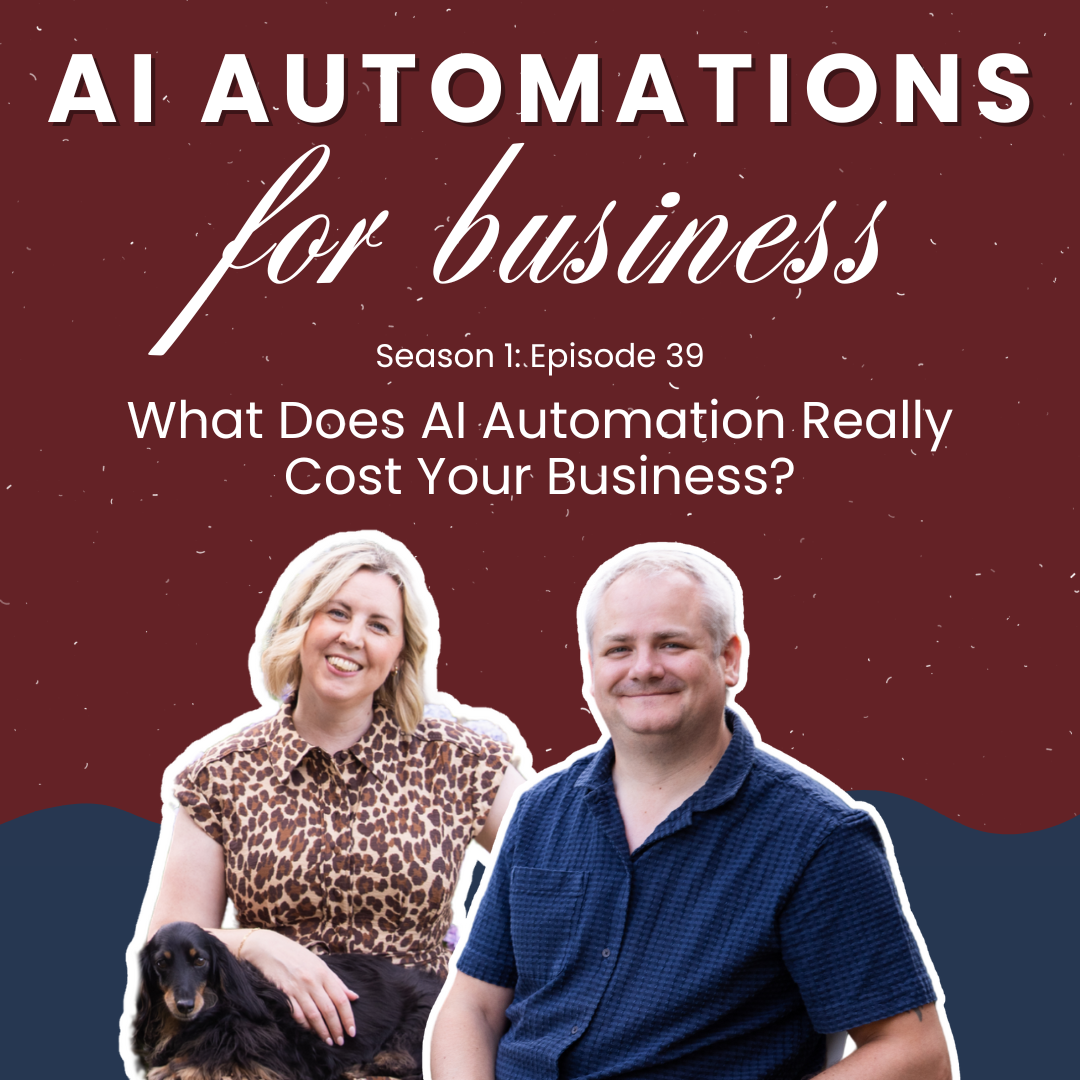
Wondering what it actually costs to implement AI automations in your business? You're not alone. In this episode, Katie and Noel break down the transparent truth about AI automation costs, from DIY learning paths to done-for-you consultancy fees, and all the hidden expenses in between.
They reveal the real costs of the DIY route, including time investment for learning platforms like Make.com, mastering prompt engineering for predictable AI outputs, and why checking your current software pricing tiers before starting could save you from costly upgrade surprises. For the done-for-you approach, they explain typical consultancy structures, including upfront implementation fees and ongoing monthly maintenance costs.
Katie and Noel also explore the often-overlooked opportunity costs of not automating, like the business executive who gained competitive advantage by delivering complex quotations in two days instead of two months, winning contracts while competitors were still calculating.
Perfect for business owners evaluating automation investments, consultants pricing their services transparently, and anyone who wants to understand the complete financial picture before diving into AI implementation.
Here are the links to episodes we mentioned.
Apple
Ep19 - Business Tips For Using AI Legally
Ep34 - How to Choose Between Zapier, N8N and Make.com for Your Business
Spotify
Ep19 - Business Tips For Using AI Legally
Ep34 - How to Choose Between Zapier, N8N and Make.com for Your Business
How to find us:
Join our membership over on Skool, where we support you on your AI and automation journey. We share exclusive content in the membership that shows you the automations we talks about in action how to build them. Find out more about the AI Business Club here.
We have a free LinkedIn group (AI Automations For Business), the group is open to all.
If you would like dedicated help with your automations or would like us to build them for you then you can find our agency at makeautomations.ai
-
Katie (00:26)
Hi, hello, welcome back to another episode. I'm Katie, and as always, I've got Noel here with me. Hey, Noel.
Noel (00:35)
Hello, yeah, really excited to jump into this topic. Yeah, this is probably the top two that I get asked all the time. Yeah.
Katie (00:43)
Okay, okay. So if you haven't read what the title of this episode is, it's all about the true cost of actually implementing AI automations into your business. So this conversation is happening because of something that we see a lot of on, I guess, around the internet. And it's not just in this industry it happens, it happens in all business industries, it's just where people kind of, you know, pluck a figure out of, you know, thin air and say that they're going to charge X amount of money and we don't want to kind of put a downer on other business owners because that's not what we're trying to do. We're just trying to kind of be an advocate to you guys in the fact that we want to make sure that if you do want to implement AI into your business, that you're totally transparent and you know the real cost of what it's actually going to cost you and your business.
Noel (01:50)
Yeah, there's a lot of things to consider and we're going to go through everything step by step. So yeah, it gives you a good oversight as to the real costs that comes when implementing any sort of AI solution into your business.
Katie (02:06)
Yeah, so we've got some bullet points that we're going to work through that cover different things that you may or may not have thought about. So obviously, let's start with the DIY option, the do it yourself option. So there is obviously some upfront work that needs to be done for that, isn't there, Noel?
Noel (02:14)
Yes, you kind of need to, you first need to understand your business processes and kind of the main aim of what you're trying to automate. I mean, that's the big, big aim for the start. Otherwise you don't know what you're going to build. And yeah, it's kind of then figuring out, well, have I got time to learn this? Because obviously there is quite a bit to learn. So you might be new to this. It doesn't mean you can't learn it. Obviously you can. Anyone can. But yeah, it's kind of like, do I have the time to dedicate to this? Is it going to take me a couple of days or is this going to be weeks to get to the end point? Because maybe what you're after is maybe quite complicated. Who knows? So yeah, it does vary.
Katie (03:00)
Yeah. It's making sure you've got time to maybe learn the software and then learn how to create the actual automation itself, isn't it?
Noel (03:28)
Yeah, yeah, definitely.
Katie (03:39)
And I guess as well there's time that needs to go in to learning how to train. I don't know, maybe the agent, the chatbot, or maybe you have to learn prompt engineering because you haven't learned that yet. But all really doable, just know that there's time involved within that.
Noel (04:03)
Definitely. Yeah. Because what I would say when it comes to the prompt engineering side is it's one thing talking to something like ChatGPT on a daily basis. That's yes, that's prompt engineering, I guess in a way, but the way that it works through like the API and your automations is, you know, you want like a predictable outcome every single time. You know, if it's like filling out documents or forms, it's got to get it right first time every time. So there is quite a bit to learn in that area. You know, just to, I would say, I wouldn't say actually, it's probably not quite a bit actually, you know, it's just understanding how the LLMs work and which ones are going to work best for you and then how to get those outputs. Yeah.
Katie (04:49)
Yeah. And then obviously with the DIY version, you might then have to pay a subscription to learn all of these things. You know, like we have our membership, the AI Business Club, where people pay a monthly subscription to come and learn how to do everything themselves. So it's not just time. It's not just prompt engineering, but obviously there is a cost to learn how to do it. But obviously I feel that actually is a really good return of investment. If you haven't got the money, but you've got the time, I feel like this is a really great option.
Noel (05:33)
Yes, definitely. Yeah, you know, 100%.
Katie (05:36)
So that leads us nicely into the done for you part of what we want to talk about. So this is more of an option, I guess, if you don't have time, but you have the financial resources to invest in your business.
Noel (05:57)
Yeah, yeah, the way it normally works would be you would pay like an upfront fee to, you know, get everything set up. There'll be an element of consultancy going on there to understand your business because only you know it as well as, you know, yourself. So, yeah, they need to understand the business, they need to understand your automations, your outputs, and then go off and implement that. And then also then there is the ongoing maintenance. A lot of consultancies would charge you a maintenance fee per month to look after all of your automations and make sure everything's up and running, as well as maybe even adding new features. Who knows? Depends who you ask, I suppose.
Katie (06:37)
Yeah. We'll talk a bit more about, I think, ongoing maintenance costs, because I feel like that is an important cost to understand whether it's done for you or you're doing it yourself. So let's definitely talk about that more in just a second. Obviously, there is cost with tools, the software, subscriptions, usage. Do you want to just talk a bit about those and let people know like what costs to expect for each of these different categories?
Noel (07:15)
Yeah, so I would say you've probably already got applications and tools already within your business. So one thing that I would do before you even think about going, well, I'm going to automate this in Make or Zapier, whatever, is check your plan first, because a lot of people fall into this trap first of all. And they'll be like, well, I can go off and connect an API and then they don't realise that they've got to upgrade a plan to be able to then get an API key to connect it into automation apps. So I kind of have a look at what you already pay currently and what are the platforms that you pay for and make sure that you can actually access the outside world. A lot of these apps also have like their own AI built in. So obviously assess that as well before you kind of like export it out to, you know, like a Make or Zapier to go off and, you know, do all this AI stuff for you that might already be built into the platform.
Katie (08:23)
So how would someone check if their plan allowed them to have an API key? How would you check that?
Noel (08:32)
They usually have it in their pricing tables on the website. Some of these apps, there might be, you know, tens of rows, but there will be something in there that would say like external integration or really call it out as saying, well, look to get API integration, you need this bit here and there'll be a tick box. So yeah, some are really open with it and then some kind of hide it. It depends what application it is, but yeah, you might have to do some digging, but yeah.
Katie (09:03)
Or reach out to their customer support. Yeah.
Noel (09:05)
Yes, yeah, yeah, their support should be able to answer that for you. Yeah. But I guess once you've figured out what you've got and you can get it out to these apps, the next step is then figuring out which automation platform I'm going to use. And we did an episode about that a few weeks ago. So where we compared n8n, Zapier and Make. So if you're still on the fence, probably check that out as well after this episode.
Katie (09:16)
Yeah, we'll leave the link for that episode in our show notes.
Noel (09:37)
Definitely. And they all price differently and they all have like their operation usage and things like that. So yeah, I would do a bit of digging. Straight off the bat, Make.com is the cheapest for all of them from like getting started. So, you know, that's probably where you'll end up. So yeah.
When you dig into a paid plan, I mean, it is only like nine or $10, depending on monthly or annual. So, you know, it's not a huge amount of money we're talking about to get those sort of platforms. Zapier is a lot more and then n8n is kind of in the middle. Spoiler alert from the other episode, but yeah. So yeah, it's kind of, and then once you've kind of figured out like your automation platform that you're going to use, you know, you're happy with what you're getting for the price and that you can actually integrate your tools into those platforms. The next big thing to look at is the large language models that you're going to use. So if you're going to use AI, I mean, you don't have to, but you could build automations where you're sending data from one thing, you know, and then splitting out and then putting it somewhere else, you know, that doesn't need AI to do that. You can just set those up normally.
Katie (10:54)
Yeah. No, and sometimes you are just redirecting people as well, aren't you, with the automations. So people are landing on a page and it redirects them to a checkout. And then once they've checked out, it means that they get an automated email and yeah, and stuff like that. So it doesn't always need to be AI. I think, look, we were having this conversation earlier and how like, automations have been around for a long time and I can remember using them, you know, back in my previous business, I think back in like 2014 or something, using an automation and actually not really almost knowing it was an automation. So the, you know, they've been around for a long time and probably most businesses use an automation without maybe realising.
But it's now that we've got the AI automations, you know, and obviously we can do so much more, you know, now we've got AI. I think then people kind of think, well, what is the additional cost? Because obviously we are using, you know, a large language model or, you know, we're thinking of usage limits, aren't we? Instead of just kind of like, you know, maybe before when we were using Zapier, we were just like, well, this is like two zaps. So it was kind of very clear, like what it was costing you.
Noel (12:34)
Yeah, definitely. Yeah. And obviously like the platform like Make, they have credits so you can, and that is an easy currency to understand. But when we get into the large language models, that kind of, it's different for each, but they all use tokens. So one thing that I, because sometimes I come across is like people are like, they're saying, well, I pay $20 a month for ChatGPT. Surely I'm already getting API access already. And it's like, no, these, so to get a large language model on the API is a completely separate thing. You've got to set up accounts with whichever provider you would like to use, adding all of your billing and things like that. And then you finally get that golden API key that you can plug into Make.
So, but I think you kind of also need to assess like, well, what's my use case? And obviously then which language model is going to be the best to use or which one would I see as being like the kind of like future proof. So I know I'm getting something good now and I trust that this company is going to keep giving me, you know, advancements that are going to be, you know, really, really helpful for my business and my automations, which is kind of, I guess, kind of difficult because of the speed this industry moves. Yeah, it's kind of just, I think you would probably have to set up like accounts with like Google Gemini, Anthropic and OpenAI, just initially just to try them out and then find out which one works for you and then just stick with it because you only pay for what you use on an API. Like I said, they'd use tokens. So you can have like, so the tokens would be what you put in, in terms of text or files. That would have an input token cost and then there's an output token cost, which is your, you know, whatever it gives back to you. And usually the output is higher priced than the input because obviously it's, you know, it's done a bit of work to get there. So there is a higher charge, but yeah, they make it all super clear on all of their websites as to the costs for every single model.
But in terms of like figuring out, you know, is this going to cost me a fortune? You know, you could just run it once. You could see the token costs and then work it out from there. But really to do even a complex job is not going to cost you more than, I'd be surprised if you spent more than $2 even on like the highest model. You know, you would have to be doing something ridiculously complicated using loads and loads of tokens in order to accrue that sort of cost. So usually an automation through an LLM is like 10 cents. So yeah, it's not gonna, yeah, per use, yeah. So it's not gonna cost the earth, yeah, you do need to, there is that testing element, try and figure things out.
Katie (15:36)
Per use. Yeah. Okay. So let's go back to talking about ongoing maintenance that we briefly touched on earlier.
Noel (15:54)
Yeah. So I guess if you're doing the DIY kind of thing, then like your ongoing maintenance would be all of your, you know, your token usage with AI models. It would be whatever tools you're using on a monthly basis, your automation platform. And I guess also, you know, as businesses, you should probably also be thinking about your time in also as maintaining those. So, you know, obviously you've, most people would have like their hourly rate. So yeah, you kind of, you know, is it taking too much of my time to keep this running? It shouldn't do. It should just work for you. But you know, it's one of those things you need to consider. But when it comes to the done for you, obviously the monthly costs would be a lot higher than they would be on the DIY, mainly because you're paying for someone's, you know, time and expertise to keep these things going to maintain your accounts. Some might be like well, you know, you're on my accounts for these, for like Make or whatever so, you know, you're paying that plus a bit more and then that you might even be using their LLM or AI models and things, so, you know, you're paying that token usage as well on top. So most people make that super clear as to what you're getting. So yeah, I just, yeah, so if that isn't clear, then do ask those questions. Wherever you ask. Yeah.
Katie (17:23)
Yeah, that's a great tip. Okay, so now we've got the compliance and privacy consideration, which I think a lot of people don't think about, but I know we've spoken about this quite a lot over different multiple podcast episodes that we've done ever since we had Lucy Wheeler in who talked all about how to be AI compliant in your business. Again, we'll leave a link below in our show notes for that. But yeah, Noel what do you want to share about compliance and privacy considerations?
Noel (18:12)
Yeah, so I think a lot of people or businesses will be obviously very much aware that they don't want to be giving data away. And I would say actually, this question is probably the second one after this topic of how much is it going to cost? And it's like, well, what's the security concerns? It's okay. So yeah, it's a very, very popular question. But what I would say is you need to look at the applications that you're using. So you would look at, you know, say you've gone down the Make.com route and then gone, right, well, how compliant are these guys? You know, because I'm sending my data through that platform. So, I mean, they've got like SOC 2, GDPR and all sorts of different certifications. So it would be going off and finding that information. And then the AI models, you know, so OpenAI, Anthropic, Google. They've all got their own separate stuff as well. And that's probably the one, the sticking point really with security is the AI side that we've come across. So they don't care that it goes through Make.com. They're like, whatever, even though it's got the same security implications as putting it through an AI. But so here, what we'd always say is, you know, obviously check that compliance, but what we find out and what, you know, what we've learned over the years of using it is when you use the API, it's incredibly secure. It's fully encrypted, the data is deleted after X amount of days, they can't look at it and they can't train their future models based on your information. So if you're putting sensitive business information in there, then you can be fairly rest assured that you know, it's all safe. I mean, anything on the internet or you know, anywhere isn't really that safe in the grand scheme of things. There's always going to be those nefarious actors that might find a way of getting that information, they can only do the best that anyone else can do. And I would say these AI guys, they're handling so much information, they've got to be all over security. So it's very safe.
Katie (20:30)
Yeah. And what about if you, so that's kind of if you're doing the DIY of, you know, AI automations, but what about when you're hiring someone to create an automation for you, how can you ensure that what they're actually building you is compliant?
Noel (20:36)
So what a good consultant would do would be discuss all of the tools that you're going to use before they use them.
Katie (21:02)
Are you talking about yourself then?
Noel (21:05)
I would put myself in that bracket, yes. So I would say, look, you know, these are the things we're going to use. These are the things I'm going to put in the middle to get from A to B, you know, and we'll sit down, discuss it, figure it out. And then there might be something they say, well, a good customer will go away and then be like, well, I've never heard of this. I'm going to go off and do a quick check first. I mean, I would supply the information anyway to say, well, here's their compliance information, here's links or whatever. And then it's up to them to approve it kind of thing. There's also kind of like an element of trust as well when you're giving this sort of stuff to a third party, because obviously they're getting into the nitty gritty of your business. So there does need to be an element of trust with that person. Yeah. So they're not just going to take your data and run to the hills with it and create a product and sell something that, that's, yeah, not, I haven't come across any instances of that happening, of course, but yeah.
Katie (21:56)
Yeah, yeah, that really does. Yeah, so I know like when you're building out certain automations, there is, you know, that not only compliance, but privacy and like GDPR. And I think like, you know, a lot of people don't talk about all of this stuff, because it's not overly like, sexy or cool, or it's not going to make you, you know, 30k in, you know, 30 minutes or something. So what would you say like to anyone who's worried about the compliance, privacy or, you know, making sure they are GDPR compliant when they're trying to put in an AI automation or just an automation, I guess.
Noel (23:00)
I guess you just do a lot of research, really go into the weeds of every single tool. I mean, you probably would have done that anyway to get like your CRM you use or, you know, whatever other business tools you use, maybe your accounting software or whatever. So you would have already have kind of done that anyway. So it's kind of getting into that mindset of, you know, keep digging until you feel comfortable that you're, you know, happy that whatever you're sending from A to B is fully secure or as secure as it can be. So yeah, that's what I would say.
Katie (23:37)
Okay, so let's just kind of change it up a little bit. So we've kind of looked at things that are gonna cost you money, you know, tools, you know, maintenance and things like that. But let's flip it and just look at actually the time you could lose as a business owner on repetitive tasks.
Noel (24:09)
Yeah, with the time loss, you know, this is something that's really, really important to figure out because there's going to be lots of tasks that you're doing on a daily basis when you're a business that, you know, takes you away from maybe delivering things to customers and things like that actually earning the money for the business. And there's lots of admin that needs doing, you know, we run our own businesses and we're sick of admin. And then, we just ship it off to an automation to do it for us. So, yeah, there is that element of figuring out what those are, what's really consuming your tasks, whether you've got, you might have staff, so it's then figuring out what's taking up their time that I can free up for them to do something else, something more meaningful for the business and start earning more money.
Because when it comes to scaling a business normally you would be like well I want to double my revenue for the year so then I'm probably going to have to hire more people but actually if you tuck those tasks, those repetitive tasks away from those existing people then you've made a small investment but then you'll see the bigger return at the end of the year. Yeah, very important to get rid.
Katie (25:30)
Yeah, absolutely. Also as well, don't think like when you're thinking about the cost, you aren't necessarily always thinking about maybe like the lost opportunities that you're, I guess, missing out on because maybe your time is going towards certain tasks which means like you're saying, I don't have time to do this. I don't have time to do that. Which means like maybe you don't have almost time to scale your business. Like you haven't created that scalable business model as well, which I think as well, you know, is a huge missed opportunity.
Noel (26:20)
Yes, massive. Yeah. And I was chatting to a business executive earlier this week. And his boss basically was like, well, how do I get more of that guy's time to do the stuff that he's really good at? And they went off and tailor built loads of automations for him to take all of those rubbish jobs off of his hands, you know, so he could actually go out and then start being more productive and then, you know, more business. Because I think it was kind of in the business development sort of area of the business. So, you know, he could have more face time with customers, you know, he could figure things out and, you know, it was giving him so much time back. But actually one thing he did mention was the speed of his automations and how that then gives them the competitive edge. So he was saying they did a quotation for some work and he said that it went through the automation in a couple of minutes. But with the cost of what they sell, there's a lot of due diligence and checking. So it took a couple of days, but they got the quote in two days. And then they were like, well, that customer got back to me and said, well, you've kind of got it because the other people have not got back to us. And it's been like two months.
Katie (27:24)
So they won the work because the other companies that they had asked to quote for still haven't got back to them.
Noel (27:41)
Yeah, yeah, they were like, we're still working on it. So, yeah, we even saw like the presentation that gets output from like their automation, there's a lot of information in there. And I could see if you were doing that manually, and there must have been like 30, 40 slides on there with like all kinds of statistics and prices. And yeah, it was very complicated. But yeah, this little...
Katie (27:50)
Yeah. Yeah, isn't it great what AI can like generate for you, honestly?
Noel (28:17)
It is brilliant. Yeah, there was a five step process in Make I think it was. And yeah, it took like two minutes to run and it done all of that. But if you were going to do that manually, and if that was like something, although it's incredibly important to the business to get that, you know, maybe you want somebody to be creating that but maybe if you had AI creating the draft of that, then it will be a lot easier for that person to then check it, update it and then get it sent. So it's not taking them, you know, days, it's taking them an hour or two.
Katie (28:47)
Hours. Yeah. Just a few hours rather than yeah, like days. Yeah. That's a great example actually of like how it can like save those opportunities and you know, how you can win them in your business instead of losing them. So I think that's really important to think about when you are thinking like, well, what actually is the true cost of having these AI automations. And as well, like for me, it's also like peace of mind, it's organisation, it's giving your brain some space as well. Because it means like, if you're not so stressed out and you're allowing AI automations to help you within your business that allow you to actually...
You know, for example, if your team is on Slack and there's Slack messages going and pinging off like literally every couple of minutes and you haven't got time to look through all of the Slack messages, but you just want, you know, where your name's been mentioned or tasks have been set for you on Slack or people have asked, can you do this? What's the answer to this? And you can just get those summarised and sent as an email, like think how much time that saved you. Because as well, I think, I heard this stat, like once you've been interrupted from a task, it takes you something like, I think it was 18 minutes to get refocused. I mean, it would take me about eight hours to get refocused, I'm not gonna lie.
Noel (30:39)
I know it.
Katie (30:46)
But yeah, so then like there's so much time wasted just in that. I'm talking about like tasks like that that can just give you that brain space, you know, and help you with organisation and it might not necessarily have a direct, you know, ROI. But actually in the long run, it is really helping you because you're going to be more productive in your business.
Noel (31:20)
Yeah, 100%. Yeah, I guess you could take that to the next level. So where you've got like an email, obviously you've got to sit down and read that. But if you're either creating voice notes, you could listen to that anywhere on two times speed as well. So you could get through it.
Katie (31:29)
Yeah. Well, obviously, because I don't listen to anything on like normal speed. Everything's at least 1.5.
Noel (31:38)
Exactly. And I'm a slow reader. So it's gonna take me ages to get through that email.
Katie (31:46)
Yeah. And you can almost be like multitasking as well. Like if you want, like if you've got, I don't know, like if you want to like leave the office and think, right, I'm going to do a bit of work later or you've got to, you know, stop working, drive somewhere. I don't know. Maybe you've got to go and do the school pickup or, you know, you've got to go and take the dog out for a walk. You could be listening to that whilst you're on the school pickup or walking your dog or you know making a cup of tea or something.
Noel (32:22)
Yeah. Space age, that's what that is.
Katie (32:29)
Yeah, I think it's really cool. I really like some of the things that you can do. And I always, always love like what really cool stuff people are doing with like AI automations as well.
Noel (32:44)
Yeah, yeah, they look, but when I saw that guy's presentation, I was like, I was telling them you can, you know, you can do that. That's fine. But the amount of detail in that was like, wow, okay, I was blown away by that. I was like, that is very impressive. I tip my cap to that one. That was very good.
Katie (32:57)
Yeah. Amazing. Well, we really hope that you have enjoyed this week's episode. If you want to come and tell us what you've been creating with your automations or AI, we would absolutely love to hear it. Just get in touch with us. You can either email us, we'll leave our email address in the show notes, or come into our free LinkedIn group, which is called AI Automations for Business. If not, we will catch you next time for another episode very very soon. Thank you so much for listening.
