
S2. Ep20 - The AI Glow-Up: What's Changed Since Last Year
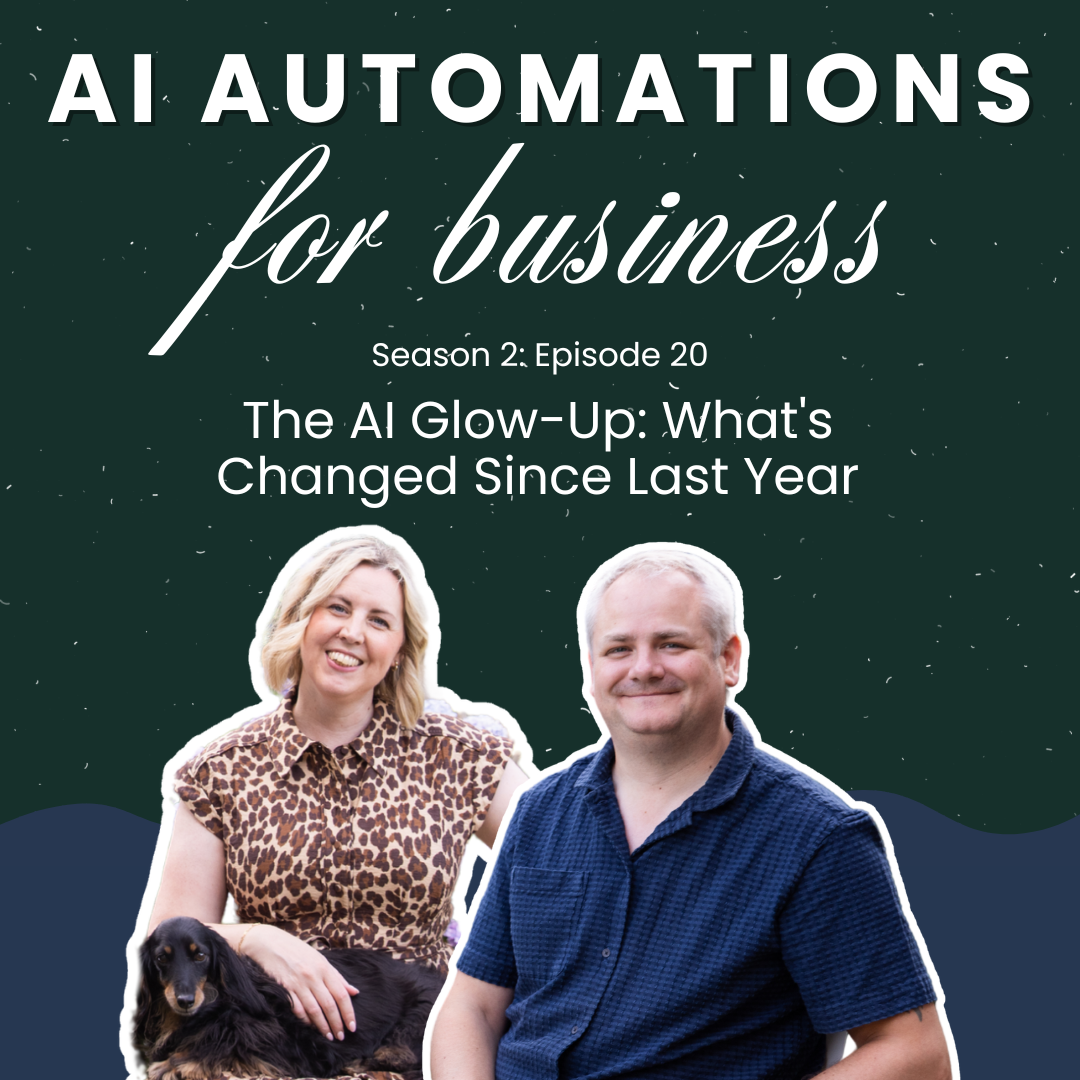
Can you even remember what AI was like a year ago?
In this episode, Katie and Noel look back at how dramatically AI has changed in just 12 months from eight-fingered images and constant hallucinations to building entire apps hands-free and AI that remembers everything. They cover ChatGPT's explosive growth from 400 million to 800 million users, the rise and fall of AI browsers, why vibe coding actually works now, and how computer use has changed the game.
They also share a Project Clyde community update, discuss the surprising demographic shift in AI adoption, and reminisce about a Malta trip that made them realise just how fast everything has moved.
How to find us:
Join our membership over on Skool, where we support you on your AI and automation journey. We share exclusive content in the membership that shows you the automations we talks about in action how to build them. Find out more about the AI Business Club here.
We have a free LinkedIn group (AI Automations For Business), the group is open to all.
New for 2026, you can also find us on Substack, click here to subscribe and get all the latest news and updates from us.
If you would like dedicated help with your automations or would like us to build them for you then you can find our agency at makeautomations.ai
-
Katie (00:26)
Hi, hello and welcome to another episode. Hi, I'm Katie and as always I have Noel here with me. Hi Noel, how are you doing this week?
Noel (00:36)
Yeah, I'm doing great this week. Nothing's fell off since my 40th birthday. So yeah, all good on my end.
Katie (00:42)
Good, good to hear. And if you've never listened before, before we jump straight into the main subject of the podcast, Noel always gives us a little update on any newness in the AI and automations world. So any updates this week, Noel?
Noel (01:09)
Would you believe it? Not really, no. Not in the mainstream sort of sense. I've had Claude doing a lot of research. He did a lot of digging for me to see if there was any nuggets out there that I'd missed. But in general, no, it's been a quiet week. But on the Project Clyde front, on the other hand, it's been a very busy week.
Katie (01:14)
Okay. Do you want to tell us about that? If people have never listened to the podcast before and they're like, what is Clyde? Give us a quick overview and then come and tell us all about your updates.
Noel (01:45)
Yeah. So Clyde is an AI agent which you can basically pitch as like your business partner. So he can create loads of sub-agent teams which are all specialised to do whatever tasks you need to do in your business. So it could be finance, marketing, HR, whatever you wish. And it will go off and create them. It creates all the prompts. It creates all the skills and it basically learns over time as well.
The other big plus point is we can connect to any API that's out there, any webhook, any MCP server. So all of your apps can be basically connected into Clyde. So it's kind of like your one-stop shop for your AI and working in your business. Yeah, that's kind of roughly what Clyde is. But yeah, this week we've been really busy with the community. So we've got a Skool community.
At the moment we've got a number of members in there, they're giving me lots of feedback and a few guys are giving me some bug reports to fix, which has been great. And yeah, it's just been going really, really well this week. We've got video and image generation all interlinked in the platform. So you can just ask Clyde to go off and create whatever you need. And yeah, he'll go and do that for you and all that sort of good stuff. But yeah, overall, lots and lots going on in the background.
So yeah, if you want any behind the scenes, then you can join the community. It's completely free. And yeah, get in on the action. And as an extra side note, actually within the community, you can also earn like rewards and benefits towards the Clyde platform once we launch it. So yeah, you can get like a percentage off on your subscription fees or we can add in like different bits so you could have extra agents or extra teams added to your account as you go, as you progress. So yeah, lots of things going on.
Katie (03:44)
Yeah, and that free community is hosted over on the Skool platform, isn't it?
Noel (03:48)
It is, yeah. Skool.com forward slash Clyde. Nice and simple.
Katie (03:51)
Okay, so if someone went on Skool and just typed in Clyde, they should be able to find it.
Noel (03:59)
They should do, yes. I've put it in the discovery, which is new on the platform. Yeah, the search is a lot better these days.
Katie (04:04)
Okay, good. Okay, exciting.
Noel (04:13)
Yeah, really exciting. Not far from launching it now. So yeah, it won't be long.
Katie (04:20)
Exciting. Okay so let's dig in to this week's episode, what AI can do now that you couldn't do a year ago. And we've had some fun talking about this behind the scenes, haven't we Noel? Because we were thinking back to when Noel and I took a trip to Malta and we met up with one of our friends we know from another AI group. And we were looking back at conversations that we would have had with Kevin then compared to maybe like conversations we would be having now if we saw him. And it kind of blew our minds a little bit, didn't it?
Noel (04:59)
Yeah, exactly. There's like terms and phrases which we use every single day now that weren't even a thing back then. We kind of dabbled with that sort of stuff. We knew it was kind of coming, but yeah, it kind of all exploded last year. And we're kind of now getting to the point where those things are becoming a bit more useful than what they were.
Katie (05:19)
Yeah. I would definitely say the later half of 2025 is when the AI world really exploded into the online world, because now I feel like so many people are saying that they are AI experts and they've been using AI for like six months.
Noel (05:59)
Yeah.
Katie (06:02)
We've had this conversation many times on our podcast. It's just like AI changes so fast. Actually, you can become an AI expert actually very quickly. And we have seen that. Like everyone seems to be building their own apps or offering like AI courses, AI tutorials. It just seems like it's gone crazy in the last year, doesn't it?
Noel (06:34)
It does. And then I guess when you look back, it's just looking at ChatGPT in like 2025 to now. So they've doubled their monthly user base from 400 million to 800 million, which is just ridiculous.
Katie (06:50)
It's like insane to think 800 million people have signed up for ChatGPT, whether they still use it. But they've signed up.
Noel (07:02)
Yeah, that's the thing. And they even got an extra hundred million already in the first two months of this year as well. So they're not far off a billion monthly active users.
Katie (07:14)
And a lot of these people would have got into AI and ChatGPT when things were still really clunky.
Noel (07:23)
Yeah.
Katie (07:24)
Kind of unreliable. The responses weren't great. I mean, can you remember those first set of images when people had like eight fingers and things looked nothing like you? Even video was really bad. You couldn't really integrate the business tools, they were still very limited. I guess you could integrate some, but the integration was very limited, wasn't it?
Noel (07:55)
Hugely limited. They could kind of cherry pick the big websites and the big apps, but if you used anything that was outside of that, then you were kind of stuck. I guess it wasn't impossible to connect it, but you did need some technical knowledge in order to make it happen. Whereas now you can just get on and do it.
Katie (08:13)
And I'm guessing that's why now there are so many more people using it and so many more people claiming to be AI experts, because actually it is so easy to use now. There is basically no tech barrier. If you can communicate with AI, then you're a winner.
Noel (08:36)
Exactly. I mean yesterday I felt like I was living in 2056 yesterday afternoon. Whilst you were out yesterday, I had Claude working on two apps and a website whilst I was just sat back chilling listening to Spotify. I was like, wow, I'm living the dream here. And all of it worked. When all three had finished, I was like, yep, that's what I want, thank you very much. 12 months ago, that would have been painful.
Katie (09:12)
Yeah. And what's funny as well, I've seen people moaning on Facebook. So I'm friends with a lot of business owners on my personal Facebook profile. And it's been really funny to see some of their posts in the last few months go from really hating AI, saying we're never going to use it, why would anyone use AI, it's a bunch of rubbish, doesn't sound like you, yada yada yada, to them going, who wants my AI cheat sheet? Or who wants to know how I used AI to make me an extra $100,000 this month? And I'm like, love to see it.
Noel (09:46)
Yeah. But I guess actually a lot of that demographic on your account is probably female business owners, isn't it?
Katie (10:15)
No, it's male as well. And actually I would say some of the men that I'm friends with are the ones that have been more vocal about not using it and then using it.
Noel (10:27)
That's an interesting thing because actually there's a demographic switch on ChatGPT. So when it first launched, it was like 80% men, 20% women. And then now it's actually 52% women. So it's slowly converged and crossed over in the last few months.
Katie (10:42)
Well, for example, the first Make.com conference you went to in Munich, you said it was like 99% male attendees. And then when we went to Munich in 2025, the winter of 2025, I would say there was about 70% male attendees, 30% female attendees. There were a hell of a lot more women there than I thought there was going to be after what you had been saying about it the previous year. And I think again, if we do go this year, I feel like there's going to be even more hopefully females attending.
Noel (11:24)
Yeah, I'd say about that. Yeah, it's definitely picking up, isn't it? Because I think, I don't know, we kind of get into the job bias and I wouldn't go down that route, but usually technical roles are usually filled by men in the general workforce, aren't they? But I know in the past few years, that's kind of all changing over. And we're starting to see lots more women get into this sort of area.
In fact there was a news report a few weeks ago about this sort of stuff and God they were so outdated. It was like, there's so many women using it, they were like oh it's bad, all men using AI, and I was like no it isn't.
Katie (12:29)
You should have emailed them the corrections. Yeah, her team need to do some better research. Maybe they need to use AI to do their research.
Noel (12:47)
Probably should have done. Crazy.
Katie (12:52)
Okay, so I would say from last year to this year you can trust AI a lot more because I feel like it makes fewer things up. Would you agree with that?
Noel (13:01)
Hugely. Yeah, so hallucinations were a huge problem. I mean, when GPT-5 came out, that was a hallucination mess. It was billed like the next Messiah, and it was absolutely terrible, wasn't it? I just think the models now, they're kind of just spoiling people. If you're getting into AI today or even in the last couple of months, you really are spoiled with how good they are. Because last year and previous to that, I mean think back to when I was using GPT-3 and stuff like that, some of the things it would get wrong. Horrific. Whereas now most of that's gone, hasn't it? I mean, it still does make things up every now and then, it's not infallible just yet, but it's a lot less frequent than it used to be.
Katie (14:07)
Yeah. I would also say now AI can connect to more tools, more software, but also it can build your own software tools and apps and you don't need any coding or tech experience. Again, if you can communicate with AI, then you can build your own software tools and apps.
Noel (14:48)
Oh, 100%. I was chatting with people about this yesterday when I was talking about living in 2056 and they were kind of like, I can't believe it, surely it wasn't that bad. And it was like, well, back a year ago, you would use tools like Lovable as an example. And God, I used to get so frustrated with it because you would ask it to do something and then the app would fail to compile and it would just crash. And it'd be like, come on. And then you'd have to go two or three times to fix the error. And then when it fixed it, whatever you asked to be built would show on the screen. And then you'd be like, that's not what I wanted. And then you'd have to go back through that cycle again.
Whereas I think now I'm probably running into maybe one, possibly two at most a week where I'm hitting sort of like big crashes. And I'm using it a lot at the minute. So for anyone else just getting started, I wouldn't be worried about it. AI can fix its problems now. It does a lot of internal tests before it says that it's done. So it will have a look and check it first. So yeah, it should be pretty much workable from a simple prompt, which is absolutely incredible. A year ago, you would have liked that to have been possible, but yeah.
But I also find like, let's say you're building an app for your business and you want to connect a software application into your app or whatever. Maybe you want to create a central dashboard or whatever. So you've got your Notion or your CRM plugged into it and things like that. You don't really even need to go off and find the technical documentation to say, I want to do this. Here's how to do it. Here's the technical docs to do it. You can just ask for it. And as long as you're clear enough, the coding agent will go off and do that Google search, find those docs, and then just do it for you. So you're not having to do much manual work these days, which is absolutely baffling.
Yeah, really awesome. You can build all sorts these days, which is great. You should start doing some, I think, Katie. Give it a go. You'll be surprised.
Katie (17:17)
Really? All right, I will. All right, well, we'll have a chat after.
Noel (17:29)
Exactly. We'll see what you've built next week.
Katie (17:33)
Okay, sure. Never say never. I'm always up for a challenge.
Noel (17:42)
Absolutely, why not?
Katie (17:46)
Okay, so the next thing is what AI can do now that you couldn't do a year ago, is AI that can use your computer or browser for you.
Noel (17:58)
Yeah, that didn't exist for a long time in 2025, but it's now really started to become quite popular and actually quite useful. You can have like, I don't know whether Claude, so it could be Cowork. So you could connect that into your browser. So let's say you've got an application or a website up on your browser. You can just say to Cowork, could you just go off and do this for me? Whatever tasks you need to do. And it can quite competently go through a website and just do those things for you these days, which is absolutely fantastic. I love using it to be honest. It saves so much time. So much button clicking. I haven't got time for that. Go and sort that out for me.
But yeah, I think looking back at it though, AI browsers seem to have died a death. I don't see anybody talking about them because we had like OpenAI had Atlas, Perplexity had their own.
Katie (18:54)
Yes! Oh my god, I'd so forgotten about Atlas!
Noel (18:54)
And exactly. No one ever mentions it. We did a whole episode on the AI browsers and back then they were brand new. And I was like, I could see a general use for this. This is really cool. But I've never used it. Within like two months of that episode, I'd say I've not touched it, mainly because like what we say with the computer use, it just goes, well, I'm just going to load it up on Google Chrome. I'm just going to use that tab in your browser you've already got open. It's like, great. Go for it. Go wild.
Katie (19:23)
Gosh, yeah, I totally forgot about them.
Noel (19:50)
I think that was seven months ago we did that episode.
Katie (19:55)
Okay, so not even a year ago.
Noel (19:57)
No.
Katie (20:00)
I'd love to know actually, if anyone still uses them. If you do, let us know and let us know how you use it, what you use it for. We're always so interested in how people are using AI, aren't we? Because there are so many different ways to use it. So yeah, do email us at hello@makeautomations.ai or you can come and join our free LinkedIn group, which is called AI Automations for Business. Anyone's welcome to join it. We just have little chats in there.
If you want to show off what you're doing or how you're using AI, you can absolutely post in there as well. We always love hearing it. But yeah, Noel, you have meetings with people who also run AI businesses and you hear about some of their clients and how they're using AI and you tell me how they're using it and it just fascinates me. I'm just like, that is so cool. That's such a great way of using it.
Noel (21:22)
Yeah, it is interesting because you can sit there and ideate with AI for hours and not come up with some of the ideas we've heard of, or even people that we've met in person and chatted with. And it's just like, okay, that's really cool. Technically I know it's possible but I just never even thought of doing it. So yeah, it's incredible.
Katie (21:40)
Yeah, do let us know either through our LinkedIn group or via email and we'll give you a shout out on the podcast if you want us to. So the other thing that I have just thought of is that AI now can handle long complex tasks without stopping or forgetting, which is fantastic.
Noel (22:28)
Yeah, it is. I mean, I know last week we covered the memory stuff, didn't we? And that's a massive help. But using those long research tasks, I've rarely hit the limit these days of the context limit. So we used to be using ChatGPT or Claude in the early days and you'd be talking with it, ask a question about something you've mentioned way up in the chat and it's completely forgotten about it. You've got to retrain it again or give that information back. And it was painful.
Whereas now either we can have such long conversations with it. I've got conversations that are going on and on and on in some of my things. And it's incredible. Especially with the coding agents as well. Some of the things that they can do and the amount of time that they can run and still just get it right these days is just baffling. When you see it running for like 20 minutes without any input and it's just like, yep, I'm done now. It's like, wow, okay. Written thousands of lines of code or we've had a really long research conversation. It's created documents, charts and it understands everything that we've done.
Katie (24:05)
Yeah. Also, for me, it's when you have a chat and sometimes it used to be chatting away to it and then all of a sudden it would have a memory lapse and almost forget about the previous conversation that you've just had. Can you remember that?
Noel (24:27)
Yeah, used to drive me up the wall.
Katie (24:38)
It's just like, I'm still on the same chat, we're talking about the same thing, but you've now just decided to forget everything because we've been chatting for 15 or 20 minutes. Whereas now you can go back to that same chat a few days later and it still has the memory, it still gives you an accurate response. And that memory is just amazing compared to even seven or eight months ago.
Noel (25:11)
Definitely. Because with ChatGPT, they weren't very clear on when you hit your context limits. So once the conversation had got so big, normally what happens now is it condenses the conversation and basically gives itself a little summary. And then you can carry on and it references that summary. That's kind of roughly how it works. But with ChatGPT, they kind of hid it. Whereas with Claude, they make it really obvious. You'll ask a question and it'll go, right, hold on a minute, I need to condense everything we've talked about. And it shows you, I'm still thinking about it, I'm working, but this is what I'm doing. And that's such a simple thing to do, but it's so much better.
And even if you say to Claude, well, we talked about this last week. And it'd be like, right, you know what, I'm not even going to wait for the order to tell me to search, I'm just going to search through those chats, find it, understand it, and then carry it on. It's like, well, I wish I had that years ago.
Katie (26:28)
Yeah, I'm really excited to see where we are again in another year's time or even at the end of the year.
Noel (26:40)
Yeah, definitely. I said to some people, I was like, I would want to get a time machine. I would vibe construct a time machine because, you know, vibe coding. I want to vibe construct it. Then travel just six months, not years, just six months. See where we're at, see what we're doing and then come back and then be ready for it. I would also nick some lottery numbers as well while I was at it because, well, I would need that for the token usage. I've got to pay for the habit somehow.
Katie (27:12)
That's just being greedy. Okay. Or maybe you could have just invested in Claude or ChatGPT.
Noel (27:24)
Well, exactly. You can't yet. They're not on the stock exchanges yet. Soon.
Katie (27:30)
I thought OpenAI was. Okay, there's been talks about it. That's why I was thinking they are.
Noel (27:35)
They're almost. Yeah, it's close. I think they're probably waiting for Elon Musk's lawsuit to disappear. That's probably not good press for going public. Who knows? Going to make some billionaires.
Katie (27:50)
Yeah, so if you want to share your AI throwbacks with us as well, then please let us know, get in contact with us. And thank you so much for listening to this week's podcast episode. It's been really fun to reminisce and go back and remind ourselves of how far AI has come in the last year or even six or seven months ago.
Noel (28:22)
Yeah.
Katie (28:24)
Really excited to see where it is at the end of 2026 as well. But thank you so much for listening. We hope you've enjoyed it and we'll catch you next time for another one very soon.
